Safe. Reliable. Back on the ground.
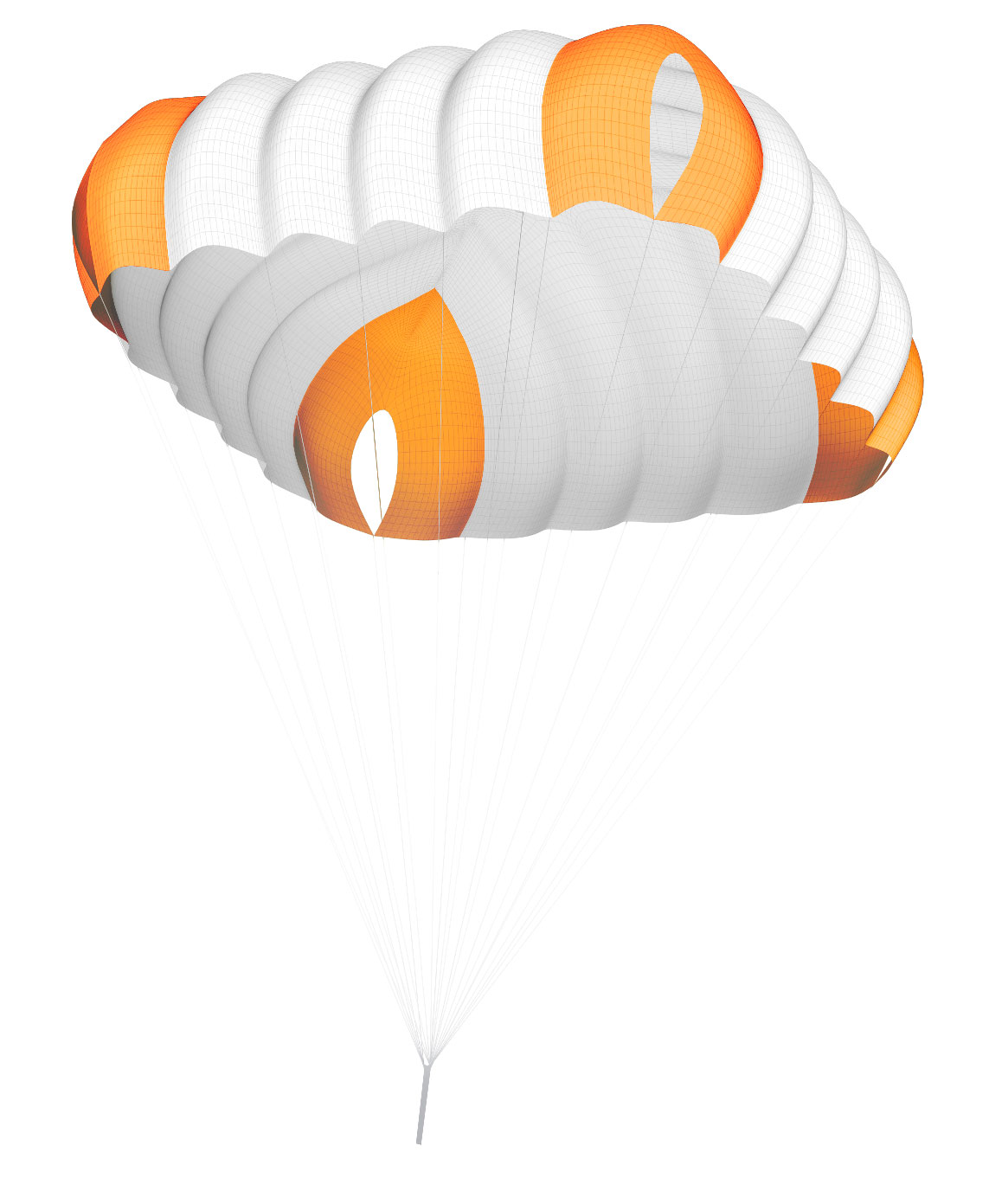
When every second counts, you need to rely on your reserve parachute. The PEPPER CROSS LIGHT2 was designed to offer you the highest level of safety in critical situations. Thanks to its sophisticated cross-canopy design, it delivers an exceptionally short opening time and high pendulum stability – features that can be crucial in an emergency.
The generously sized canopy area ensures a low sink rate, while the symmetrical design minimizes drift. The result: a smooth, stable descent and the best possible conditions for a controlled landing.
But safety doesn’t have to be a burden. The PEPPER CROSS LIGHT2 combines its performance with a low weight and compact packing size. In its smallest size, it weighs just 1 kilogram.
The thoughtful design is also evident when packing: The numbered loops make it easier to pack the rescue gear neatly and organized. The eye-catching two-tone design also improves visibility and makes it easier to spot from the air and on the ground. High-quality, durable materials also ensure that you can rely on your equipment for many years to come.
With six sizes for tow loads ranging from 55 to 225 kilograms, the PEPPER CROSS LIGHT2 covers a wide range of applications. From ultralight solo adventures to professional tandem flights, it offers added safety for virtually any scenario.
Low weight in your pack, strong when it counts.

ROBUST MATERIALS

HIGH DESCENT STABILITY
FAST OPENING TIMES

MINIMUM DRIFT

LOW SINK RATES
| Size | 90 | 105 | 120 | 135 | 180 | 225 |
| Area flat (m²) | 26.9 | 30.1 | 35.8 | 40.1 | 52.9 | 65.5 |
| Weight (kg) | 1.0 | 1.1 | 1.35 | 1.5 | 1.95 | 2.3 |
| Maximum load (kg) | 90 | 105 | 120 | 135 | 180 | 225 |
| Packing volume (l) | 3.8 | 4.0 | 4.8 | 5.6 | 5.7 | 6.6 |
Which size PEPPER CROSS LIGHT2 should I fly with?
Check the technical infos of the different sizes (90, 105, 120, 135, 180, 225) and look carefully at the maximum load figures. Your all-up in-flight weight (this includes your bodyweight, clothing, boots, helmet, canopy, harness, reserve, instruments and anything else you might be carrying) – should correspond to the maximum load rating. This ensures minimal sink velocities and injury free landings.
Will the PEPPER CROSS LIGHT2 fit in my harness?
The inner container volume is clearly marked on all PEPPER CROSS LIGHT2 reserves and must be observed during a conformity check. Most newer harnesses also indicate the minimum and maximum inner container volumes which can be fitted to their deployment containers. Check on the harness itself or in the harness handbook. It is important that the inner container volume lies within the constraints of the harness deployment container volume. Volume information may not be present for older harnesses.
What is the correct way to pack my reserve?
We strongly recommend letting a qualified expert pack your reserve for you. Routine and experience ensures optimum pack form and smooth and speedy deployment. If you really want to pack your reserve yourself, then follow the packing instructions in the handbook carefully. Again, visiting a packing instruction course is highly recommended to gain experience and learn from the experts. Reserve handbooks can be downloaded from our website.
Check the packing video here
What should I observe when fitting the reserve to my harness?
We strongly recommend letting your reserve be packed and fitted by a qualified expert. Ensuring that the reserve is compatible to the harness and correctly attached to the load loops is just as important as having it correctly packed. A correct compatibility check can only be performed with a trial deployment. Check your reserve regularly – flying at costal sites can in particular lead to corrosion problems around the release splints. Only correctly packed and fitted reserves guarantee your safety!
What is a compatibility check?
During a compatibility check a trial deployment is made under the careful observation of a qualified expert. The check tests that the reserve can be easily released from the harness and inner container with the deployment handle. It is most important that nothing obstructs this proceedure. Correct reserve attachment to harness load loops and that the reserve is the correct size for the deployment container is also checked. Once all the checks have been made, the reserve inner container needs to be re-fitted to the harness in exactly the same way as before!
How often should a reserve be re-packed?
We recommend re-packing a reserve every 12 months, or immediately should it have come in contact with water. Regular re-packing helps speedy and reliable deployment in the event of an emergency. Packing and fitting should be performed by a qualified expert. We also recommend regular pre-flight checks of container splints and deployment handle attachment – release and re-attach any velcro strips and move the splints a little to prevent them from getting stuck tight. If you’re flying costal sites or in the winter, check your reserve more regularly for any signs of corrosion.
When should I replace my PEPPER CROSS LIGHT2?
The reserve must be replaced after 10 years, even if it has never been thrown. The rescue device must also be replaced if any damage is visible.
Does the PEPPER CROSS LIGHT2 drift to achieve its sink rate?
The PEPPER CROSS LIGHT2 as well as the SALSA2 are symmetrically constructed and do not have a system-induced forward motion.
Do the rescue connection lines need to be connected by a steel screw shackle?
An alternative option is to connect the two lines by a loop connection. Generally, loop connections are not less secure than screw shackle connections (as long as this is possible and useful at all ). In addition, loop connections save weight.
Attention: skywalk equipment offers the possibility to connect harness to the reserve chute via a loop. It is possible that equipment from other manufacturers is not designed for this. In any case you should always find out for yourself in advance, if necessary, you can always use the screw shackle.
Your PEPPER CROSS LIGHT2 package
- PEPPER CROSS LIGHT2 Rescue chute
- Inner container
- Neoprene cover